
KNOW THE SIGNS: Knife Crime Prevention
- Research & Articles
Beyond the Blade—Social Determinants and Vulnerability
To address knife crime effectively, one must look past the physical weapon and into the socio-economic drivers that lead an individual to carry one. In 2026, experts increasingly view knife crime through a “public health lens,” treating violence as a symptom of deeper community malaise.
Fear as a Primary Catalyst
Contrary to popular belief, the majority of young people who carry knives do not do so with the primary intent to attack. Research from the Youth Justice Board (YJB) indicates that “defensive carrying” is the leading motivation. In areas where trust in traditional policing is low, a blade is often viewed—erroneously—as a tool for personal safety.
The Impact of Deprivation
Data consistently shows a correlation between high-incidence areas and economic deprivation. In boroughs like Newham and Croydon, where knife crime rates are double the national average, there are also higher levels of:
- School Exclusion: Pupils excluded from mainstream education are significantly more likely to be groomed into “County Lines” drug networks.
- Lack of Youth Services: A decade of funding cuts to community centers has left a vacuum often filled by gang structures.
- Social Marginalization: Children from Mixed and Black ethnic backgrounds remain over-represented in knife statistics.
The Role of Exploitation
The rise of “County Lines” has fundamentally changed the nature of knife crime. Criminal gangs exploit children—some as young as 10—to transport drugs across regional borders. In these scenarios, the knife is both a tool of the trade and a badge of forced affiliation.
When a Blade Strikes — the Wounds That Never Fully Heal
In the UK, a young person is stabbed approximately every 90 minutes. Each incident leaves a circle of devastation that extends far beyond the moment itself — through families, communities, and generations.
Media coverage of knife crime tends to follow a familiar pattern: a headline, a photograph, a postcode. Within days, the story fades. But for the families left behind — the parents who identified a body, the siblings who watched a brother or sister fight for life in intensive care, the friends who will never quite be the same — the story never ends. This article examines what it truly means to be touched by knife crime, not in statistics, but in lives.
The Physical Reality of a Stab Wound
It is worth being direct about what a knife does to a human body, because it is a reality that is too often sanitised. A single stab wound to the torso can sever major blood vessels, puncture a lung, rupture the liver, or damage the spinal cord — sometimes all at once. Trauma surgeons operating in major city hospitals describe knife injuries as amongst the most complex and unforgiving wounds they treat. Survival frequently depends on proximity to a major trauma centre and how quickly bystanders act.
Even those who survive face long and painful recoveries. Nerve damage can cause permanent disability. Collapsed lung injuries leave lasting breathing difficulties. Many survivors describe chronic pain years after the incident. A young person who is stabbed at 16 may carry the physical consequences for the remaining six or seven decades of their life.
The Psychological Aftermath for Survivors
Physical wounds, however severe, are only part of what a survivor must contend with. Research published by the Trauma Foundation and studies carried out by NHS mental health services consistently find that survivors of knife attacks are at significantly elevated risk of:
- Post-Traumatic Stress Disorder (PTSD): Flashbacks, hypervigilance, and severe anxiety can make ordinary life — school, commuting, being in public spaces — feel impossible. Many young survivors describe being unable to return to the street where they were attacked.
- Depression and Withdrawal: A once sociable young person may become isolated. Relationships deteriorate. Academic performance collapses. Ambitions that existed before the attack can feel entirely out of reach.
- Survivor Guilt: Particularly when a friend was killed in the same incident, survivors frequently carry profound guilt about their own survival — a burden that, without professional support, can lead to self-harm and suicidal ideation.
- Fear of Re-victimisation: The belief that the perpetrator or their associates may return is not always unfounded. This climate of fear traps some survivors in cycles of anxiety and, in some cases, drives them toward carrying a weapon themselves — perpetuating the very cycle of violence that harmed them.
Bereaved Parents: A Grief Like No Other
The death of a child is described by bereavement specialists as the most severe form of grief a human being can experience. When that death is sudden, violent, and entirely preventable, the trauma is compounded in ways that are difficult to overstate.
Bereaved parents of knife crime victims commonly describe a grief that refuses to follow conventional patterns. There is no peaceful acceptance. In its place, there is frequently:
- Prolonged traumatic grief: Unlike natural bereavement, the violent and unexpected nature of the death means the mind cannot process loss in its usual way. Many parents describe being “frozen” at the moment they received the news, unable to move forward.
- Intrusive imagery: Parents who viewed their child’s body, or who were present at the scene, can experience graphic and unwanted mental images — a form of trauma distinct from grief itself.
- The criminal justice ordeal: Families are thrust, often without support, into a prolonged and deeply distressing legal process. Court appearances require sitting in proximity to the person who killed their child. Appeals can extend the torment for years. Justice, when it comes, rarely brings the closure families hope for.
- Financial devastation: Many bereaved parents must take extended leave from work. Some never return to employment. Funeral costs, travel to court, and the need for private counselling — rarely fully funded by statutory services — place enormous financial strain on already grieving households.
Siblings and the Hidden Victims
The impact on brothers and sisters is one of the least-discussed aspects of knife crime’s legacy. Young siblings who lose a brother or sister to violence are themselves at significantly elevated risk of mental health crisis. Research from the charity Grief Encounter found that bereaved siblings frequently experience:
- Long-term educational disruption, including school avoidance and exclusion
- Behavioural changes, including aggression and risk-taking
- A distorted sense of their own safety and mortality
- A deep sense of injustice that, in the absence of support, can develop into dangerous attitudes toward retaliatory violence
These children are, in many senses, secondary victims — yet they rarely receive the same recognition or support as the immediate bereaved adult. Schools may not be informed. Counselling referrals may not be made. The full weight of a family’s grief can press down on a child who has no language to describe what they are experiencing.
Community-Level Trauma
The consequences of knife crime are not contained within individual households. Research into “community trauma” — sometimes called vicarious trauma — shows that neighbourhoods which experience repeated incidents of serious youth violence suffer measurable collective harm. Residents become reluctant to use public spaces. Local businesses close early or relocate. Teachers and youth workers report burnout driven by the accumulated weight of attending to traumatised young people.
In communities where violence has become normalised, young people develop a distorted understanding of risk and consequence. What should be shocking becomes routine. This desensitisation is itself a form of harm — one that makes future violence more, not less, likely.
The Perpetrators’ Families: A Toll Rarely Acknowledged
It would be incomplete to discuss the consequences of knife crime without acknowledging the families of those who carry and use blades. Parents and siblings of young people who are imprisoned for knife offences face stigma, shame, and often a grief of their own — the loss of a child not to death, but to the criminal justice system. Mothers who watch a son sentenced to years in custody describe an experience of helplessness that mirrors, in some ways, the grief of bereavement. These families, too, are left behind.
What Needs to Change
Awareness alone is insufficient. Safeguarding professionals, educators, and community leaders all have a role in ensuring that the full weight of knife crime’s consequences — on victims, families, communities, and perpetrators alike — is understood by the young people most at risk of involvement. The evidence is clear: deterrence works best not through fear of legal sanction, but through humanising the cost.
Decoding the Data Behind the Headlines
As of early 2026, the discourse surrounding knife crime in England and Wales remains a critical pillar of public safety debates. Recent data from the Office for National Statistics (ONS) and the Ministry of Justice (MoJ) provide a nuanced view of a landscape that is simultaneously showing signs of stabilization in some areas while presenting new challenges in others.
Current Trends and Key Figures
For the year ending September 2025, the Criminal Justice System (CJS) dealt with approximately 20,771 knife and offensive weapon offences. This represents a marginal increase of 1.5% from the previous year, yet it signifies a 21.5% rise over the last decade.
Regional Hotspots
- Cleveland: Now records the highest national rate of “assault with injury” involving a knife.
- Manchester: Reports a Violent Crime Rate (VCR) of 13.8 per 1,000 residents.
- South Yorkshire: Ranks third for overall knife-related incidents per capita.
Sentencing and Justice
The legal response to carrying blades has become increasingly rigid. In 2025, the average custodial sentence for knife possession rose to 8 months. Approximately 30.8% of all knife-related convictions resulted in immediate incarceration. Notably, roughly 69% of those cautioned or sentenced were first-time offenders.
Decoding the Data Behind the Headlines
As of early 2026, the discourse surrounding knife crime in England and Wales remains a critical pillar of public safety debates. Recent data from the Office for National Statistics (ONS) and the Ministry of Justice (MoJ) provide a nuanced view of a landscape that is simultaneously showing signs of stabilization in some areas while presenting new challenges in others.
Current Trends and Key Figures
For the year ending September 2025, the Criminal Justice System (CJS) dealt with approximately 20,771 knife and offensive weapon offences. This represents a marginal increase of 1.5% from the previous year, yet it signifies a 21.5% rise over the last decade.
Regional Hotspots
- Cleveland: Now records the highest national rate of “assault with injury” involving a knife.
- Manchester: Reports a Violent Crime Rate (VCR) of 13.8 per 1,000 residents.
- South Yorkshire: Ranks third for overall knife-related incidents per capita.
Sentencing and Justice
The legal response to carrying blades has become increasingly rigid. In 2025, the average custodial sentence for knife possession rose to 8 months. Approximately 30.8% of all knife-related convictions resulted in immediate incarceration. Notably, roughly 69% of those cautioned or sentenced were first-time offenders.
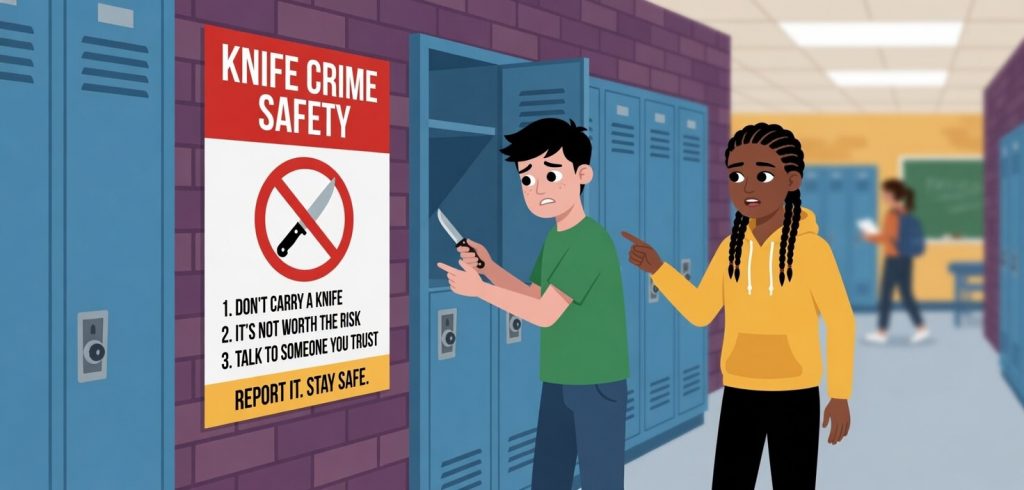
Understanding the issue
Knife crime amongst young people has reached concerning levels across the UK. Research indicates that young people who carry knives often do so out of fear rather than aggression.
Key Statistics (2024-2025)
- Hospital admissions for knife wounds in under-25s increased by 12% year-on-year
- 75% of young people who carry knives report doing so “for protection”
- Peak age for knife-related incidents: 16-17 years old
Officer-led lesson plan outline
Session Structure (90 minutes)
Part 1: Introduction (15 mins)
Ground rules, safe space agreement, anonymous question box
Part 2: Legal Consequences (20 mins)
Offensive Weapons Act 2019, sentencing guidelines, case studies
Part 3: Real-World Impact (25 mins)
Video testimony, medical professional input, “myth of protection”
Part 4: Alternatives & Support (20 mins)
Exit strategies, de-escalation, local support services
Part 5: Q&A and Close (10 mins)
Anonymous questions, resource distribution, follow-up signposting